

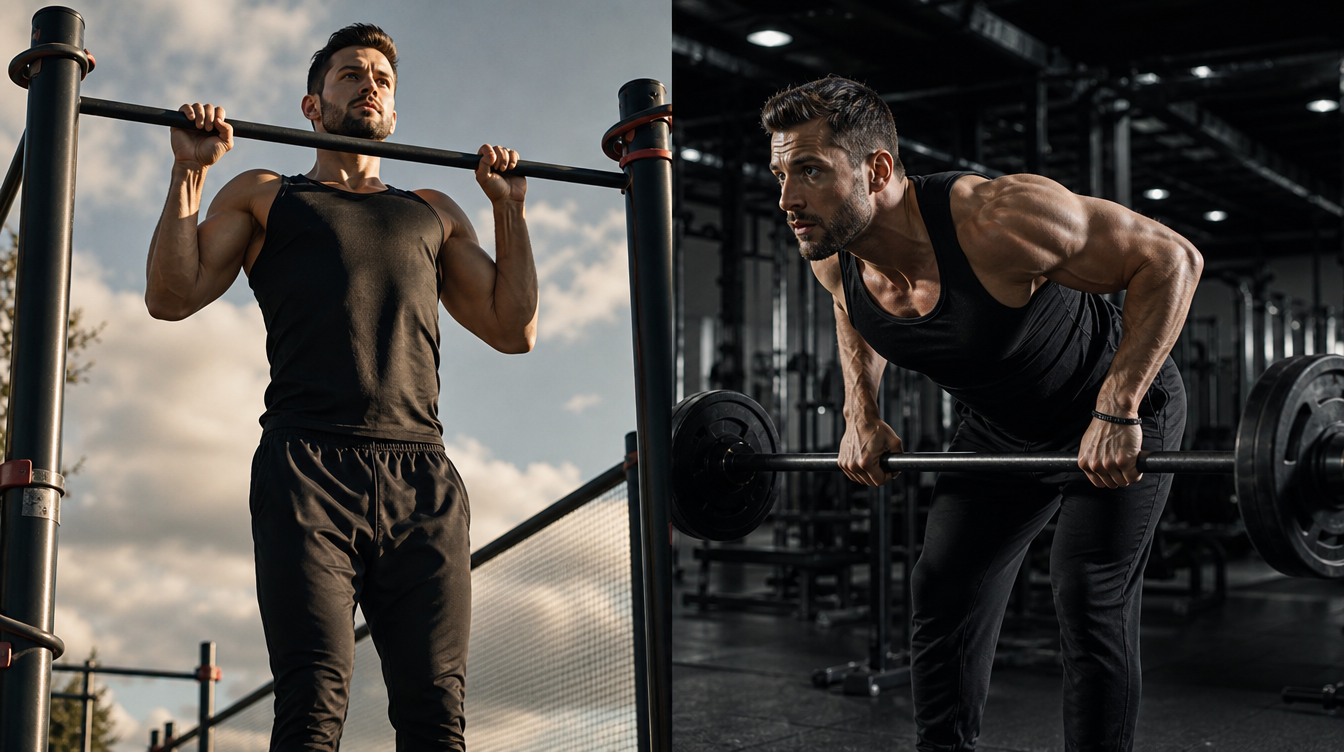
Ask this question in any gym and you'll get a confident answer — usually based on someone's personal experience rather than any actual data. So let's set the opinions aside and look at what the research says.
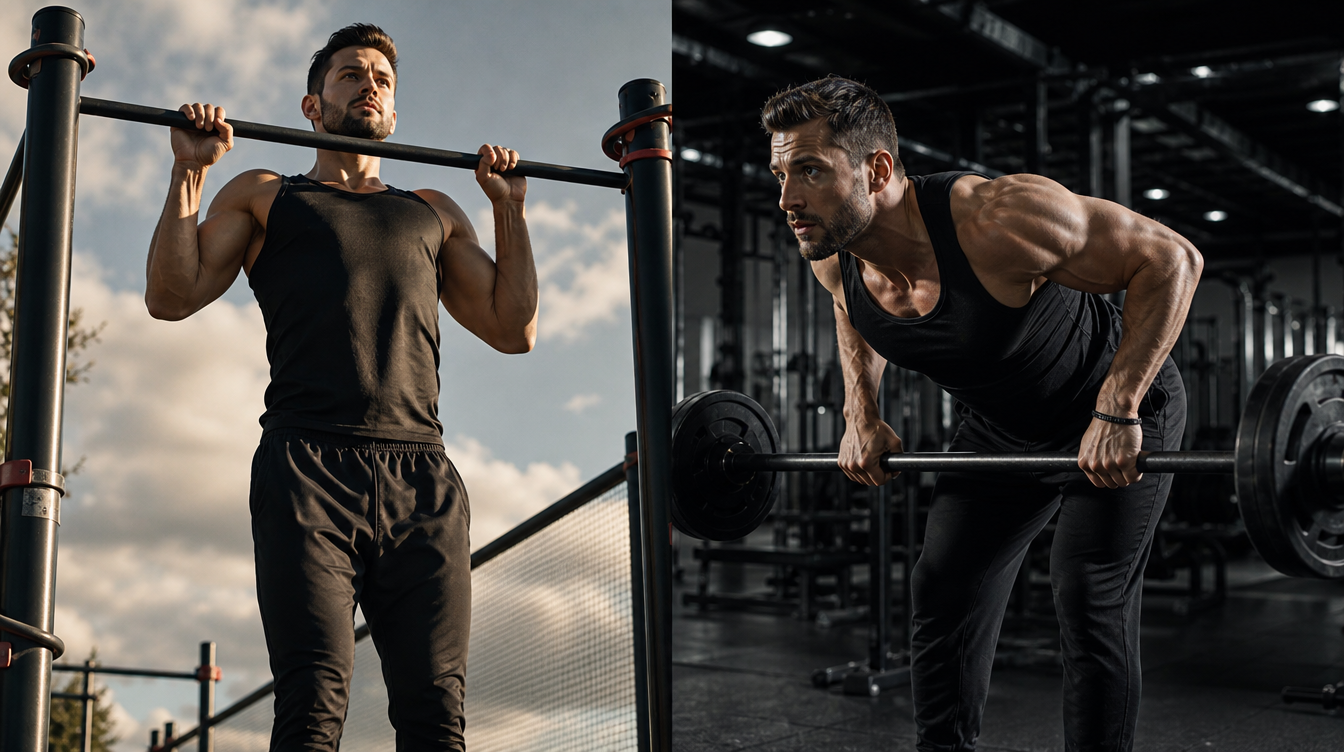
Muscle doesn't know what tool you're using
Muscle growth (hypertrophy) is driven by three main mechanisms: mechanical tension, muscle damage, and metabolic stress. None of these require a barbell. A muscle fibre under enough tension responds the same way whether that tension comes from a loaded bar or your own bodyweight held at a hard leverage point.
This is why the "calisthenics can't build real muscle" claim doesn't hold up scientifically. What matters is whether you're applying enough mechanical tension, often enough, for long enough — the training variable researchers call progressive overload. Weightlifting gets there by adding plates. Calisthenics gets there by changing leverage, range of motion, tempo, unilateral loading, or reducing rest — and, eventually, by adding external load back in (weighted vests, dip belts, bands).
What the head-to-head studies actually show
Two studies are usually cited in this debate, and they're worth knowing in detail rather than by reputation:
Kotarsky et al. (2018), Journal of Strength and Conditioning Research. Twenty-three moderately trained men were split into a progressive push-up group and a traditional bench press group for four weeks, three sessions a week. Both groups saw significant strength gains, and ultrasound imaging showed similar increases in muscle thickness in the chest and triceps. The push-up group actually improved more on push-up-specific measures. The takeaway: progressing through harder bodyweight variations produced comparable strength and hypertrophy outcomes to progressing through heavier bench press loads, over the studied timeframe.
Calatayud et al. (2015), Journal of Strength and Conditioning Research. This study matched muscle activation (via EMG) between a 6RM bench press and a 6RM resistance-band-loaded push-up in resistance-trained university students, then tracked 5 weeks of training. When EMG activation was equalised between the two exercises, both groups produced statistically similar gains in 1RM and 6RM strength. The mechanism, not the implement, predicted the outcome.
Neither study is a definitive, permanent verdict — both are short (4–5 weeks) and use relatively small, healthy, already-active samples. But they're consistent with the broader hypertrophy literature: mechanical tension and effort drive adaptation, and a well-loaded bodyweight exercise can deliver both.
Where weightlifting has a structural advantage
This is the part the "calisthenics is just as good" crowd tends to skip: weightlifting has an easier, more linear path to progressive overload. Add 2.5kg to the bar next week. Simple, precise, endlessly repeatable, and it scales cleanly for the rest of your training life.
Bodyweight training runs into a real ceiling if all you're doing is more reps. Once you can do 25+ clean push-ups, you're training endurance more than strength or size — research on rep ranges consistently shows hypertrophy is more efficient in roughly the 6–12 rep zone (though a wider 5–30 rep range can still work if you push close to failure). At that point, without adding resistance, you're not overloading the muscle in the way that drives further growth — you're just getting better at reps.
Weightlifting also has an edge for building certain muscle groups efficiently — back thickness, posterior chain, and quads in particular are harder to load hard with bodyweight alone without added external resistance or specific equipment.

Where calisthenics matches or wins
- Relative strength and body control. Calisthenics builds strength-to-bodyweight ratio and skill (levers, planches, muscle-ups) that barbell training doesn't directly train.
- Joint-friendly loading. Bodyweight movements often let you train through full, natural ranges of motion with less spinal loading than heavy barbell lifts — useful for longevity and for people managing joint issues.
- Accessibility. No gym membership required. A pull-up bar and a set of parallettes covers most of a serious program.
- Novel stimulus for trained lifters. For people who've plateaued on barbells, switching to bodyweight variations (or combining both) can reintroduce a fresh stimulus.
The honest answer
Calisthenics can build real, measurable muscle and strength — the mechanism is the same as lifting, and short-term studies back that up. But past the beginner-to-intermediate stage, bodyweight training needs a way to keep adding resistance, or progress stalls. That's the actual fork in the road: not "calisthenics vs weightlifting" as competing philosophies, but whether your bodyweight training has a built-in way to keep overloading the muscle once bodyweight alone stops being enough.
In practice, that means:
- Weighted vests for push-ups, pull-ups, dips, and squats once bodyweight reps exceed ~12–15 with good form
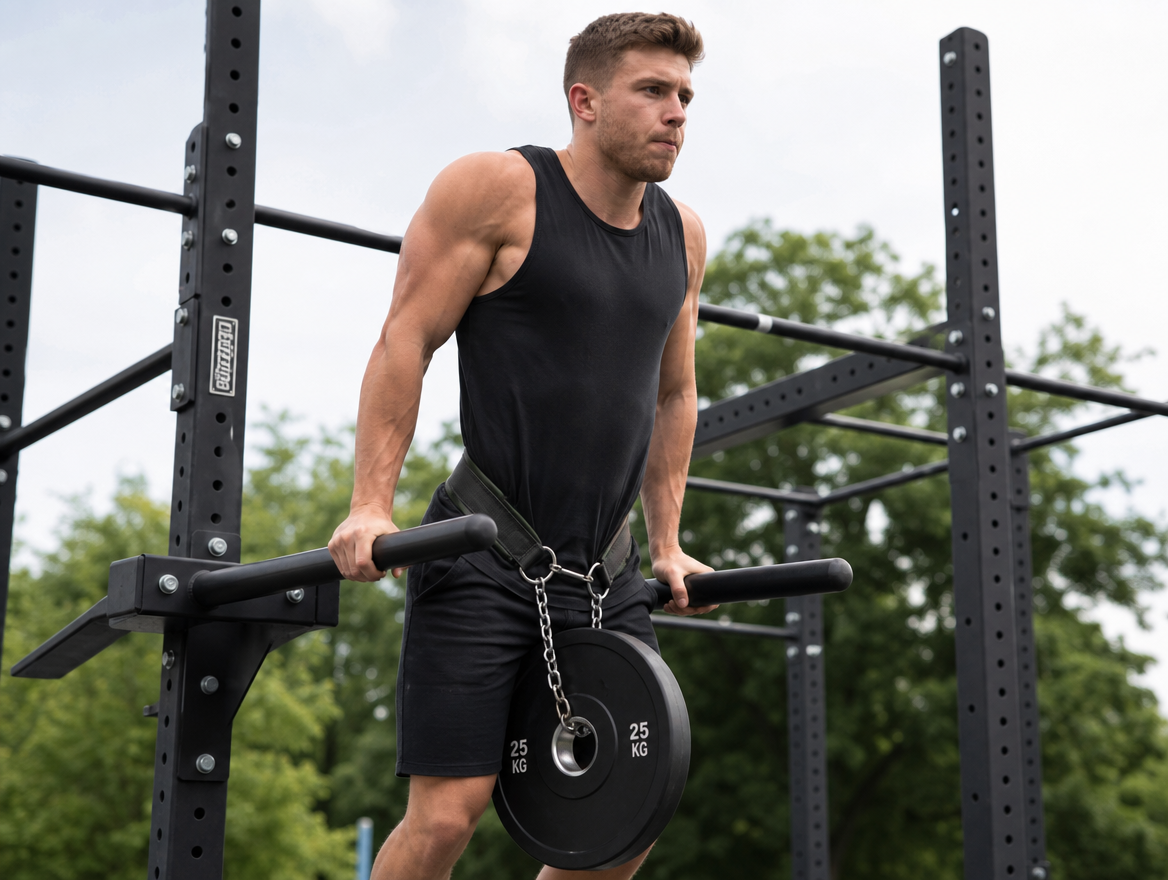
- A dip belt for loaded pull-ups and dips — the calisthenics equivalent of adding plates to the bar
- Resistance bands, used in reverse (added tension rather than assistance), for extra load on presses and rows
- Rings or parallettes for range-of-motion and leverage-based progression when you're not ready to add external load yet
None of that requires a barbell. It just requires treating bodyweight training with the same progressive-overload discipline you'd apply to a weight room — which is exactly what the research above actually measured.
The bottom line
If your goal is maximum, most time-efficient hypertrophy in large muscle groups, traditional weightlifting still has the more direct, linear tool for the job. If your goal is strength, control, and muscle built primarily with your own bodyweight — including real, visible hypertrophy — calisthenics can get you there too, provided you're progressing the difficulty (and eventually the load) the same way a lifter progresses the weight on the bar.

Train the calisthenics side of that equation properly
If you're building your program around bodyweight training, the missing piece is usually progressive load. A 12kg Adjustable Weight Vest turns bodyweight push-ups, pull-ups, and dips into a true progressive-overload tool once your reps climb past the hypertrophy range. A Dip Belt does the same for weighted pull-ups and dips — the direct bodyweight equivalent of adding plates to a bar. And if you're working toward your first strict pull-up or a front lever, the Pull Progression Pack is built specifically around that strength curve.
References
- Kotarsky, C. J., et al. (2018). Effect of Progressive Calisthenic Push-up Training on Muscle Strength and Thickness. Journal of Strength and Conditioning Research.
- Calatayud, J., et al. (2015). Bench Press and Push-up at Comparable Levels of Muscle Activity Results in Similar Strength Gains. Journal of Strength and Conditioning Research.
- Burd, N. A., et al. (2012). Muscle time under tension during resistance exercise stimulates differential muscle protein sub-fractional synthetic responses in men. Journal of Physiology.